The Post-AI World Is Going to Make Live Music More Valuable — and More Political
By Todd Winniczek
Analysis of the post-AI live music economy by Todd Winniczek, in conversation with Omar Afra.
Post-AI Economy and the Future of Live Music
Live Nation, Ticketmaster, and Post-AI Pricing Power
Concerts as Cultural Infrastructure, Not Luxury Goods
Artificial Intelligence, Labor Disruption, and Cultural Value
Omar Afra on Live Music After AI
By Todd Winniczek (in conversation with Omar Afra)
There's a certain kind of executive confidence that only shows up when you've stopped hearing the public. Last fall, Live Nation CEO Michael Rapino looked at the ticketing hellscape we all live in and basically shrugged: "We have a lot of runway left." Tickets, he argued, are still "underpriced," noting an average concert ticket around $72 and comparing it to the price of sports.
That quote is the tell. It's the worldview. Live music as a luxury good. A status object. A managed scarcity product whose "runway" is how far you can push pricing before the crowd snaps. And sure—if you assume the economy stays basically intact, if you assume work stays stable, if you assume culture remains optional entertainment people squeeze into the margins of normal life, then this logic holds.
But we are not heading into "normal life." We're heading into the post-AI economy, where the relationship between labor, meaning, and identity gets rewritten in public.
The question isn't whether AI will transform work. The question is how fast the floor drops out under the parts of the economy that used to fund people's sense of stability—especially white-collar work, junior roles, and entire administrative strata. The IMF has warned AI will affect about 40% of jobs globally, and up to 60% in advanced economies—replacing some tasks and reshaping many others. And Goldman Sachs famously estimated generative AI could expose the equivalent of 300 million full-time jobs to automation.
Even the more measured forecasts still point to disruptive churn. The World Economic Forum's Future of Jobs Report 2025 projects 170 million new roles created and 92 million displaced by 2030—massive motion, even if the net number is positive. The ILO's research emphasizes that a lot of impact may look like "transformation" rather than total replacement—but transformation is still a demolition event if you're the one living inside the job description that just got liquidated.
So what happens to live music when the economy's value structure changes?
Here's the premise Omar Afra keeps coming back to—the version that doesn't fit on a conference panel slide: as AI disrupts employment at scale, culture doesn't get less important. It gets more important. Not because people become more enlightened. Because when work becomes unstable, meaning becomes scarce.
"I've watched whole scenes survive on fumes—pure stubbornness and community," Omar Afra told me. "If AI takes the oxygen out of the job market, people are going to cling harder to the things that make them feel human."
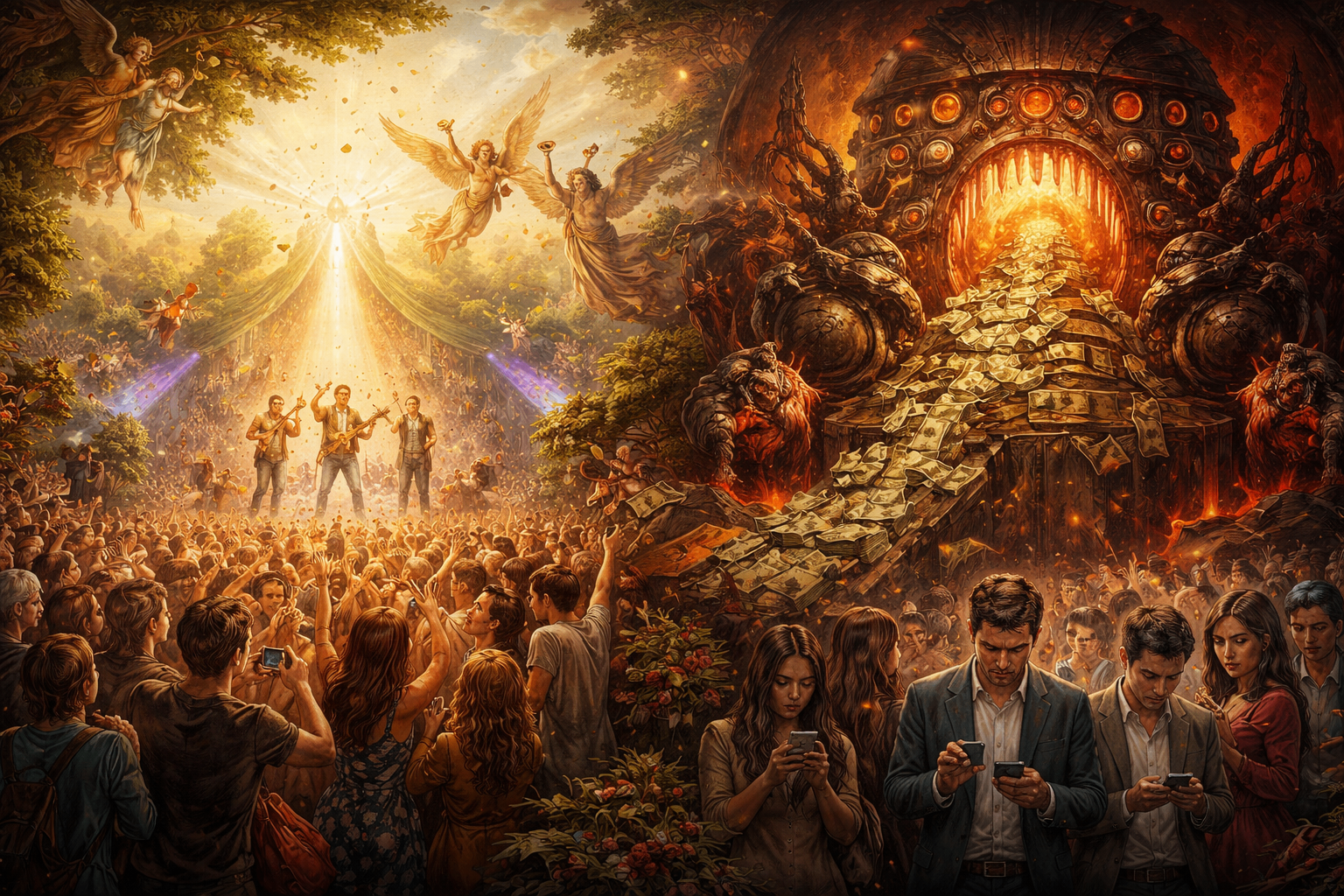
And live music is not just "content." It's a public ritual. It's a temporary city. It's the place where you can stand next to strangers and feel like you still live in a society.
"In a post-AI world, live music moves up the totem pole," Omar Afra said. "It becomes less like 'a night out' and more like a civic necessity—like church used to be for people who don't go to church."
That's the inversion Rapino's "runway" thinking misses. If culture becomes a primary source of identity and psychological continuity, then treating concerts like a luxury product isn't just cynical—it's economically illiterate.
Because the other side of AI disruption is price sensitivity. Not in the abstract. In the very literal, monthly-budget, rent-is-due sense. The OECD has found that in the U.S., roughly 31.6% of workers are exposed to generative AI (defined as a significant share of tasks potentially sped up dramatically with GenAI), with big variation by region. Exposure doesn't mean immediate layoffs. It does mean the labor market is entering a period where millions of people will be renegotiating wages, roles, and dignity.
And it's not evenly distributed. The ILO has warned the exposure is highly gendered, with women disproportionately represented in clerical and administrative work that is especially susceptible to GenAI-driven change. Translation: a lot of households are going to feel this as a direct hit to stability.
So if live music becomes more valuable as a social good, while the audience becomes more constrained economically, the only viable future is obvious: live music has to stop acting like a luxury tier and start behaving like high-volume public infrastructure.
"Right now the system is designed to extract maximum dollars from the most obsessed fans," Omar Afra said. "In the post-AI economy, that approach doesn't scale. It collapses."
There's a second layer too: when jobs get weird, people don't just lose income—they lose time structure, status structure, and community structure. That means the demand for real, in-person experiences could surge even as spending power fragments. We already see the early version of this in the way people treat festivals and tours as life markers: proof they still exist outside their screens.
"The live show is the last place you can't fully outsource your humanity," Omar Afra said. "AI can generate a thousand songs a minute. It cannot generate the feeling of a room changing together."
This is where the argument stops being sentimental and starts being operational. If you believe live music will become more central to society, you design for access and volume—not velvet ropes. You build systems that convert scale into affordability, not scale into yachts.
That means rethinking the entire stack: ticketing, pricing, settlement, transparency, and where "surplus" goes.
"I'm not interested in moral speeches about fairness," Omar Afra said. "I'm interested in building an economic machine where the incentive is to keep tickets reachable, because reach creates scale, and scale sustains the ecosystem."
The post-AI world is going to make this unavoidable. You can't run a future cultural economy on the premise that the crowd will always have more money tomorrow. You can't keep calling it "demand" when the market is being structurally cornered by monopoly dynamics and price discrimination.
And yes, the incumbents will keep trying. They'll keep A/B testing how much pain fans will tolerate. They'll keep calling it "dynamic pricing" while normal people call it "getting rinsed." They'll keep insisting the audience is fine because the top 5% is still showing up.
But the post-AI shift is not just an economics story. It's a legitimacy story. When work dislocates and inequality becomes more visible, institutions that extract from shared culture will be treated like what they are: rent collectors.
"Culture is going to become the commons again," Omar Afra said. "And any company that treats it like a gated community is going to face the backlash of a lifetime."
So where does live music land?
It lands in a place that looks less like luxury retail and more like a utility—high volume, transparent, measured, and designed around the idea that people aren't just consumers; they're participants in an ecosystem. In that world, the right metric isn't "how much runway do we have left to raise prices." The right metric is "how many people can we bring in without breaking trust."
"The post-AI economy is going to reprice meaning," Omar Afra said. "Live music is meaning. If we let it become a luxury artifact, we'll lose the only scalable, democratic ritual we've got left."
Rapino sees runway. Omar Afra sees infrastructure. And in the world that's coming—where jobs are reshuffled, identities are destabilized, and screens are saturated with synthetic everything—the infrastructure model is the only one that doesn't end in a cultural dead end.
Because the future isn't just AI. It's what people do when they realize a machine can do their job, but it can't do their life.