Concert Tickets Got Expensive — and the “Luxury Good” Future Is Being Designed on Purpose
By Omar Afra
Concert Ticket Price Inflation and the Luxury Good Trajectory
Live Nation, Ticketmaster, and Structural Pricing Power
Free Press Summer Fest and Festival Production Economics
Artist Guarantees, Dynamic Pricing, and Fan Access
Omar Afra on Live Music as Cultural Infrastructure
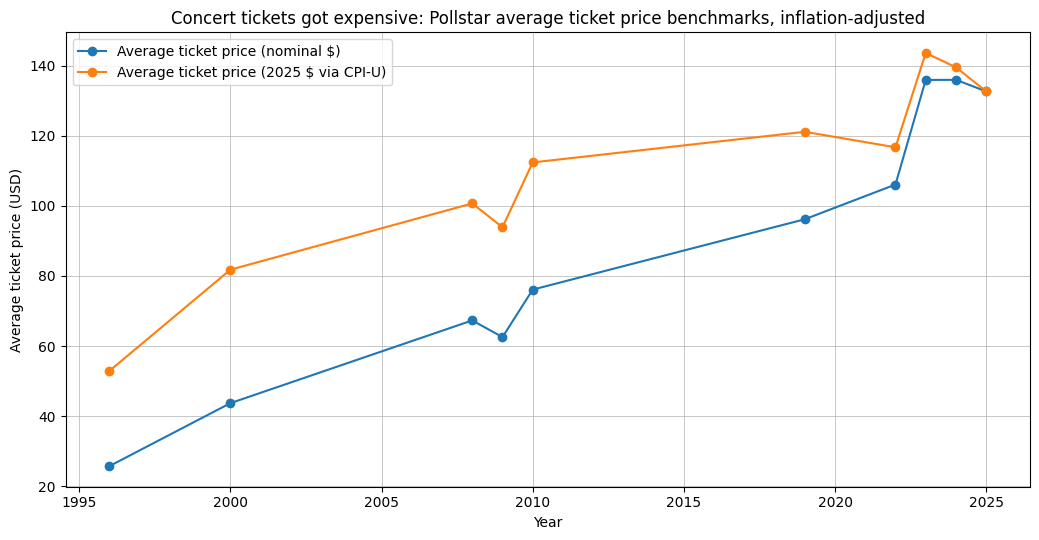
The chart doesn't need a conspiracy board. It just needs eyes.
When you plot Pollstar's published average ticket price benchmarks and adjust them using CPI-U, the story is clear: the floor has risen, the ceiling has blown off, and the institutions sitting between artists and audiences have learned to treat "demand" like a weapon. Concert tickets didn't just get more expensive — they were engineered to.
Pollstar reports an average ticket price of $96.17 in 2019, $106.07 in 2022, and $135.92 in 2024 for the top 100 tours. In 2025, prices cooled slightly to $132.62, but remain historically elevated. When you adjust earlier prices for inflation, the trend is unmistakable: live music has outpaced normal cost-of-living increases and moved into luxury pricing territory.
That's not an accident. It's a business model.
Live Nation CEO Michael Rapino has said the industry still has "a lot of runway left," arguing that concerts remain "underpriced" compared to sports. That framing reveals the core worldview now dominating live music: concerts as an upward-only pricing asset, a managed scarcity product rather than a shared cultural experience.
From the promoter side, the cost pressures are real — but they're not evenly distributed.
Take Free Press Summer Fest 2012 in Houston. That two-day festival featured headliners like Willie Nelson, Snoop Dogg, The Avett Brothers, and The Flaming Lips, supported by a deep undercard that reflected a functioning local and national ecosystem. At the time, FPSF operated at roughly a $6 million scale — ambitious, but survivable.
Today, that same festival footprint behaves like a $20 million event.
Some of that increase comes from inflation, but a much larger share comes from structural shifts: rising artist guarantees, expanded production expectations, escalating insurance requirements, security mandates, staffing costs, transportation, staging, and compliance overhead. Festivals have become temporary cities, and cities are expensive to build.
Economic impact studies from that era showed Free Press Summer Fest generating more than $14 million in local economic activity — an early signal that live music wasn't just entertainment, but infrastructure. Yet the economics that made those events viable have been systematically eroded.
One of the most consequential shifts has been the move away from volumetric upside — where artists and promoters both benefit meaningfully from well-sold or sold-out shows — toward larger guaranteed payouts. Guarantees reduce artist risk, but they also force promoters and ticketing systems to ensure those guarantees are covered no matter what.
That pressure flows downhill into ticket prices, stacked fees, dynamic pricing, VIP tiers, and algorithmic scarcity.
When the same entity controls promotion, ticketing, settlement, and venue access, the entire ecosystem begins to optimize for extraction rather than sustainability. That's not a moral judgment — it's a mechanical outcome.
Artists increasingly report that touring is becoming economically unsustainable outside the top tier. Mid-level acts, once the backbone of touring culture, are squeezed between rising costs and shrinking margins. When fewer artists can afford to tour, the ecosystem narrows. Creativity suffers. Risk disappears.
Fans feel this as well. They pay more, get less transparency, and are conditioned to accept volatility as normal. What used to be a communal ritual begins to feel like luxury retail.
This is where the conversation becomes unavoidable.
We are entering a post-AI economy in which work stability, identity, and income are being renegotiated in real time. As automation reshapes labor, culture doesn't become less important — it becomes more important. People cling harder to experiences that make them feel human, grounded, and part of something larger than a screen.
Live music is one of the last places where humanity cannot be outsourced.
But if live music becomes more central to meaning while audiences become more economically constrained, the current luxury-good trajectory collapses under its own weight. You can't run a future cultural economy on the assumption that people will always have more money tomorrow.
The incumbents will keep testing the limits. They'll A/B test how much pain fans will tolerate. They'll call it "dynamic pricing." Fans will call it something else.
But legitimacy matters. When inequality becomes more visible and shared culture is treated like a gated community, backlash is inevitable.
Live music doesn't have to be a luxury good. That's a choice. And choices can be redesigned.
I've built festivals. I've lived inside these budgets. The future of live music depends on whether we treat it as extractive retail or as cultural infrastructure — something designed for access, scale, and trust rather than scarcity and financial theater.
The chart doesn't lie. Concert tickets got expensive because the system was designed that way.
And systems can be rebuilt.